
Shopping online has gotten weird.
Not like “aliens have taken over Amazon” weird.
Just… kind of tiring.
You open a tab to look at something you want. Then you open another tab to read reviews. Then you open one more, because the first review site seems a bit dodgy.
Then YouTube. Then Reddit. Then you find a “best of” list that feels like it’s just packed with paid links.
And now you’re 35 minutes in, your brain is fried, and you still don’t know what to buy.
So when people hear “ChatGPT Shopping,” the first reaction is basically:
“Wait, does this mean I don’t have to open a million tabs?”
Yes, that’s the idea.
In this guide, I’ll explain what ChatGPT Shopping is, how it works, and how to use it safely so you don’t end up buying the wrong version of something at 3:12 AM.
Let’s start with a clean definition.
What is ChatGPT Shopping?
ChatGPT Shopping is basically ChatGPT acting like a shopping helper. Not in a “push you to buy stuff” way (at least that’s not how OpenAI describes it).
More like a helpful friend who asks, “Okay, but what do you actually need?”

OpenAI talks about shopping in two main pieces:
- Shopping research: it helps you decide what to buy by asking questions and building a buyer’s guide.
- Instant Checkout: for some products, you can buy right inside ChatGPT with a “Buy” button. Right now, it lets U.S. users buy from Etsy sellers directly in chat, and soon it will include over a million Shopify merchants too.
And yes, shopping research can be used even when you are not buying inside the chat, but still want to find something that you actually need. The basic idea of the research part is about narrowing down options and comparing tradeoffs.
And it matters because a lot of people think “ChatGPT Shopping” means “ChatGPT is now a store.”
Well, not really.
It’s more like a new shopping interface, sitting on top of regular online stores.
What it Looks Like When You Use it
Let’s start with an example to make this easy to understand.
Say you type:
“I need the quietest cordless vacuum for a small apartment.”
That’s literally the kind of example OpenAI used back then when they introduced shopping research in ChatGPT.
So it will often follow up with clarifying questions like:
- What’s your budget?
- Do you have pets?
- Carpet or hard floors?
- Do you care more about weight or suction?
And then it does the boring work for you.
It searches, compares all over the internet, looks at trusted sources, and uses what ChatGPT already knows about you from your old chats and your ChatGPT memory, if you’ve enabled that.
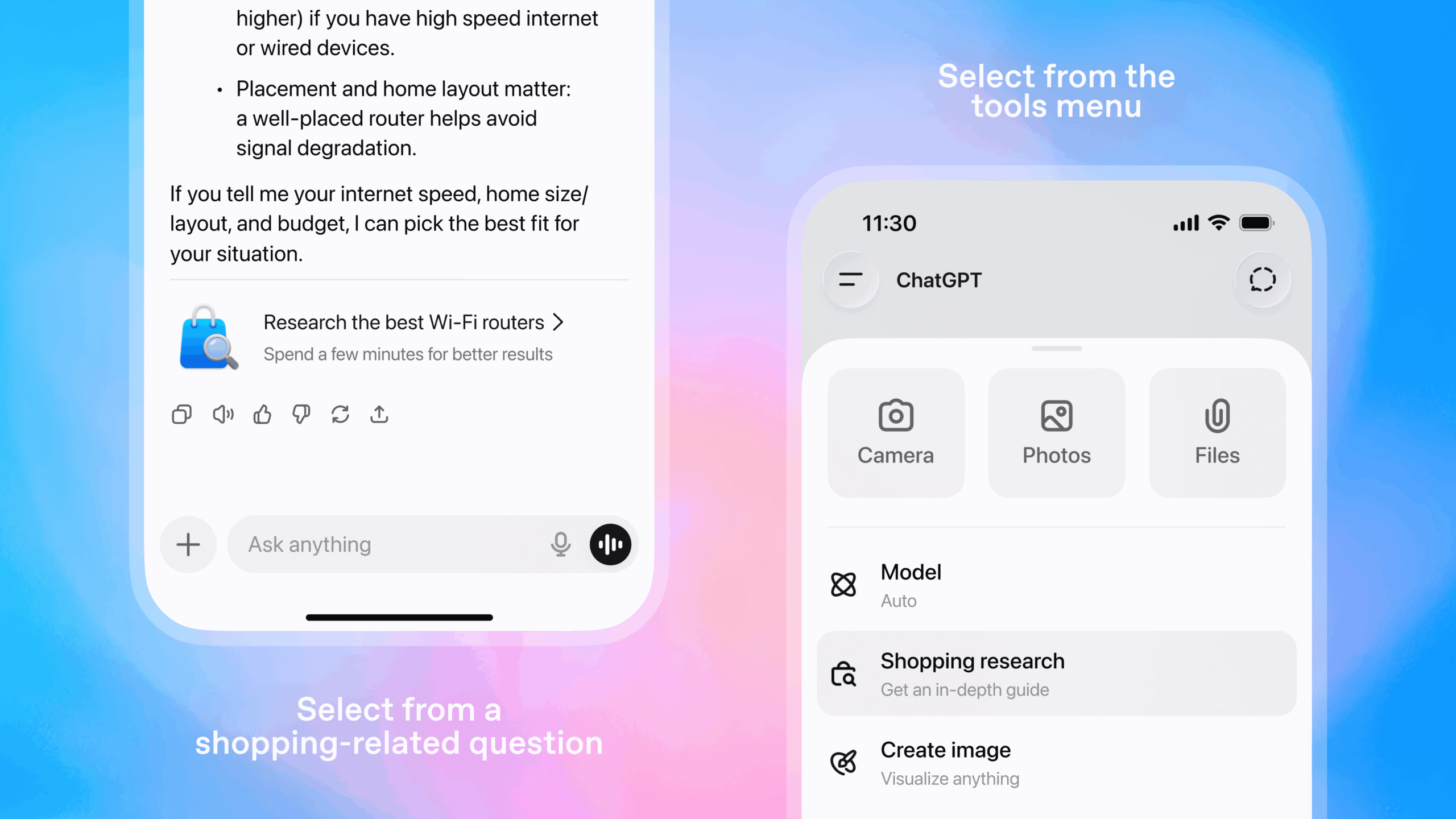
After all that, you get a buyer’s guide that actually fits you, and it takes just a few minutes.
The research flow
Here’s what usually happens:
- You say what you’re looking for, in your own words.
- ChatGPT asks you a few extra questions to get the details right.
- It checks lots of sources, compares things, and puts together a guide made just for you.
- You end up with a good list that comes with reasons, trade-offs, what’s good, and what’s not-so-good.
But one little thing that most people miss when saying what they’re looking for is that they aren’t sure which details actually matter.
But they do know what annoys them, right?
“I hate vacuums that are heavy.”
“I hate ones that are too noisy.”
“I hate paying for subscriptions.”
Even that kind of stuff is helpful, so first craft your message to include those details.
For example, you could ask something like this:
“I want a cordless vacuum that’s super quiet and light because I live in a small apartment with mostly tile floors. I have a cat, and I hate heavy vacuums and loud noise. My budget is under $200. I don’t want anything with a monthly subscription.”
That way, shopping research takes a few minutes to give you a more detailed, well-researched answer.
The “Buy” Button and Instant Checkout
This is something most people never even thought about wanting in ChatGPT, but now it’s here, and you start to think about how it could totally change how we shop online.
Imagine hitting “Buy” right inside the chat and not messing with all those extra steps. It’s kind of crazy to think about how this might change things.
So if an item is ready for it, you might spot a “Buy” button right inside the chat. That means you can grab it without ever leaving the conversation.

OpenAI calls this Instant Checkout.
According to OpenAI’s help page, Instant Checkout is there for people who are logged in as Free users, Plus users, or Pro users in the United States, at least that’s what it says right now. It works with certain items from Etsy and some Shopify stores.
So it’s not for everyone, not yet anyway.
But you can see where things are heading.
Start selling online with Shopify
Learn how to sell online, in Person, and everywhere in between.
On the other hand, with all of this impressive stuff, there’s something you need to keep in mind, because product details change fast.
Prices go up and down, stock runs out, and even models get updated all the time.
So you need to check if a product still fits what you want before you buy it.
Ask things like:
- Is this the newest version?
- Are there any details here that might be wrong?
- What should I double-check before I pay?
And really, always check and verify the final details before you buy anything.
If it costs a lot, check again.
If it plugs in, check again.
If it’s something you use on your skin, check again.
That’s not scary, it’s just how things work.
What This Means for Online Stores (and Small Brands)
ChatGPT Shopping isn’t just about making things easier for people who shop. Let’s switch sides for a second and talk to store owners.
Because when shoppers start asking AI tools to help them pick products, the way people find stores online starts to shift.
If the first place people look for products changes, then the way they arrive at your store changes too.
And that means the whole plan for getting customers (entry point) might need to change.
And then the whole strategy changes.
It won’t happen all at once.
But it’s already starting.
The game here is great product data
OpenAI’s shopping help page says that how merchants are ranked can depend on things like whether the product is in stock, the price, how good it is, who is selling it, and if you can use Instant Checkout.
Even the thumbs-up or thumbs-down you see next to a product counts as feedback, so it might affect how your product shows up, since OpenAI is continuously working to improve product results.
So you can’t just hope for the best or rely on your “brand vibe.”
You need solid, accurate product info that’s easy for people to scan and simple for AI to read.
You need clean product info, pages that a human can scan, and an AI can understand.
What I mean is, your title should say what the product is, not just sound good.
“Handmade Soy Candle, Lavender, 8oz, Cotton Wick” is better than “Summer Bliss Candle.”
Your description should cover the basics: size, material, what it’s for, who it’s for, and any limitations.
Your FAQs should answer the questions people ask before they buy, not after.
That’s it.
And yes, this is also just good eCommerce.
We all know how confusing things get when information isn’t clear. People just want things to make sense.
Why Shopify and Etsy matter
OpenAI says you can use Instant Checkout right now for some items on Etsy and certain Shopify stores, and more shops will be added soon.
If Instant Checkout isn’t available, ChatGPT will still give users a link so they can finish buying on the store’s website.
That’s important because so many small businesses are on Shopify and Etsy these days.
So this isn’t just something for the big stores out there.
So if you’re a small brand, the path is basically:
- Make sure your product info is clean and complete.
- Watch the merchant and platform support as it expands.
- Be ready to integrate (or use platforms that integrate).
Even if your shop isn’t part of it right now, it’s still worth keeping an eye on what’s happening.
In Summary
So yeah, ChatGPT Shopping is still early. Not perfect. Prices can be off, some products won’t show up, and the Buy button isn’t everywhere yet.
But the core idea, having something ask you the right questions before showing you options, is already better than what most of us do on our own.
If you run a shop, start there. Clean product info. Clear titles. Real details. That’s it.
And if you just want to buy something? Try it once. Ask it what you actually need and see what comes back.
But always double-check the details before you buy, because the prices, stock, and shipping can change or be delayed. Some products might not show up at all.
And if you have an online shop, start fixing your product pages now. Make your titles clear, list real details, add useful FAQs, and say exactly how shipping and returns work.
Not glamorous.
But it gets the job done.

