You open ChatGPT, type your question, and get an answer.
It works, sure.
But have you ever felt like… this is good, but maybe there is something better for what I actually need?
That feeling is there for a reason, and that kind of curiosity is what makes you look for better options, and in some cases, it proves that what you have is already the best for you.
So in this post, I’ll show you 5 ChatGPT alternatives that focus on different kinds of work.
Some work well for research, some are great for coding, some care more about privacy, and some are built for speed.
Let’s start with one of my favorite alternatives to ChatGPT.
In Summary
- Pick Claude 1 for more natural writing, deep reasoning, long documents, coding, and some heavy tasks.
- Grok 2 works better for fresh updates and quick takes when you want what people are saying right now in trending topics.
- Try Perplexity 3 or Gemini 4 for online facts with sources, fast research, fact checks, and use Poe 5 to test different AI in one place.
Pick your section
1. Claude.ai
Claude.ai is another great ChatGPT alternative created by Anthropic that’s great at understanding and talking like a human.

It’s perfect for both companies and regular people who want help with writing, communication, and even coding while maintaining ethical standards in their operations.
In other words, it can help you write all sorts of things, from blog posts and social media updates to quick summaries, detailed reports, and code snippets, making it a really useful tool for many different tasks.
Key features:
- Perform advanced reasoning tasks for complex problem-solving.
- Transcribe and analyze images, including handwritten notes and graphs.
- Help with coding, including website creation, JSON conversion, and debugging.
- Draft, edit, and share Artifacts like websites, graphics, documents, and code.
- Use a “computer use” feature to perform desktop tasks like web searches and typing.
- Uses strong safety measures to make sure all AI interactions are safe and trustworthy.
Pricing: Claude comes with a free tier that allows users to explore its functionalities, but with limited usage. For those seeking more usage, the Claude Pro plan is available at $20 per month.
2. Grok
Grok is another interesting ChatGPT alternative right now, built by xAI and is deeply connected with X, which means it can pull in live posts and real-time data.

This feels closer to ChatGPT, but what I mostly felt with it is the stronger focus on current conversations happening online. So if you care about what people are talking about right now, Grok can be useful.
Most of the time, it gives thoughtful answers to questions, helps with writing, explains topics, and responds in a more casual tone compared to many other AI tools.
And because it’s tied to X, it can look at fresh public posts and use that context in its answers.
Key features:
- Grok can look at recent public posts on X, so answers feel more current.
- Strong tool for trend research and public opinion snapshots
- For topics like tech updates or market reactions, Grok is often more aware of what just happened.
- Built directly into X, so you can even ask questions inside X itself
- Grok often replies in a more casual, sometimes witty way, which can feel more human
Pricing: How you get Grok depends on where you use it. On X, Premium tiers include access to Grok with higher usage limits depending on the plan. You can also get the SuperGrok plan directly from Grok for $30 per month. But it is still free to use with limited usage.
3. Perplexity AI
Perplexity AI is a strong ChatGPT alternative for searching the web. For some other people, it is also an alternative to Google, and chances are you have not really looked into it yet.

This “answer engine” is designed to give you accurate and concise answers to your questions using large language models (LLMs) and a carefully selected set of sources.
Founded by a team of engineers with expertise in back-end systems, AI, and machine learning, which makes it is a good option for those looking for an alternative to ChatGPT.
Key features:
- A chat-based search engine that provides intelligent answers to all your questions.
- Saves time by allowing you to view and cite sources directly within the search engine.
- Personalized AI profiles enhance search results based on your preferences.
- Allows you to upload and ask questions about your own files for tailored insights.
- Provides the option to narrow down searches to specific sources for precise information.
Pricing: You can use Perplexity for free or upgrade to a paid plan. Paid plans, starting at $20 per month, mostly offer higher limits and more features.
4. Google Gemini
Gemini is Google’s answer to ChatGPT, and it’s quite an interesting alternative. Developed by the tech giant itself, it’s an AI service that works across Google Workspace, aiming to help people do more.

What sets Gemini apart is that it pulls information directly from the web, making it a great alternative to ChatGPT.
In September 2023, Google introduced app connections using Bard Extensions, including Gmail, Docs, and Drive. Then in May 2025, those Workspace apps were made available for everyone in the Gemini app.
Key features:
- It can generate summaries of factual subjects, create narratives, and produce different forms of creative content.
- Users can now generate images in English in most countries.
- By integrating with Google apps and services, Gemini can provide more thorough and informative responses.
- Through analyzing images and videos, Gemini can describe objects, translate text, and identify objects within images.
- It can generate code in different programming languages.
- With its multimodal search abilities, Gemini can search for information across various types of content.
Pricing: Right now, Google offers paid Gemini plans through Google AI subscriptions, like Google AI Pro and Google AI Ultra. Prices change depending on your country, so check Google’s subscription page for your region.
5. Poe
Poe is one of the top alternatives to ChatGPT that you probably haven’t heard of yet. With Poe, you can ask questions, get quick answers, and have interactive conversations with AI.
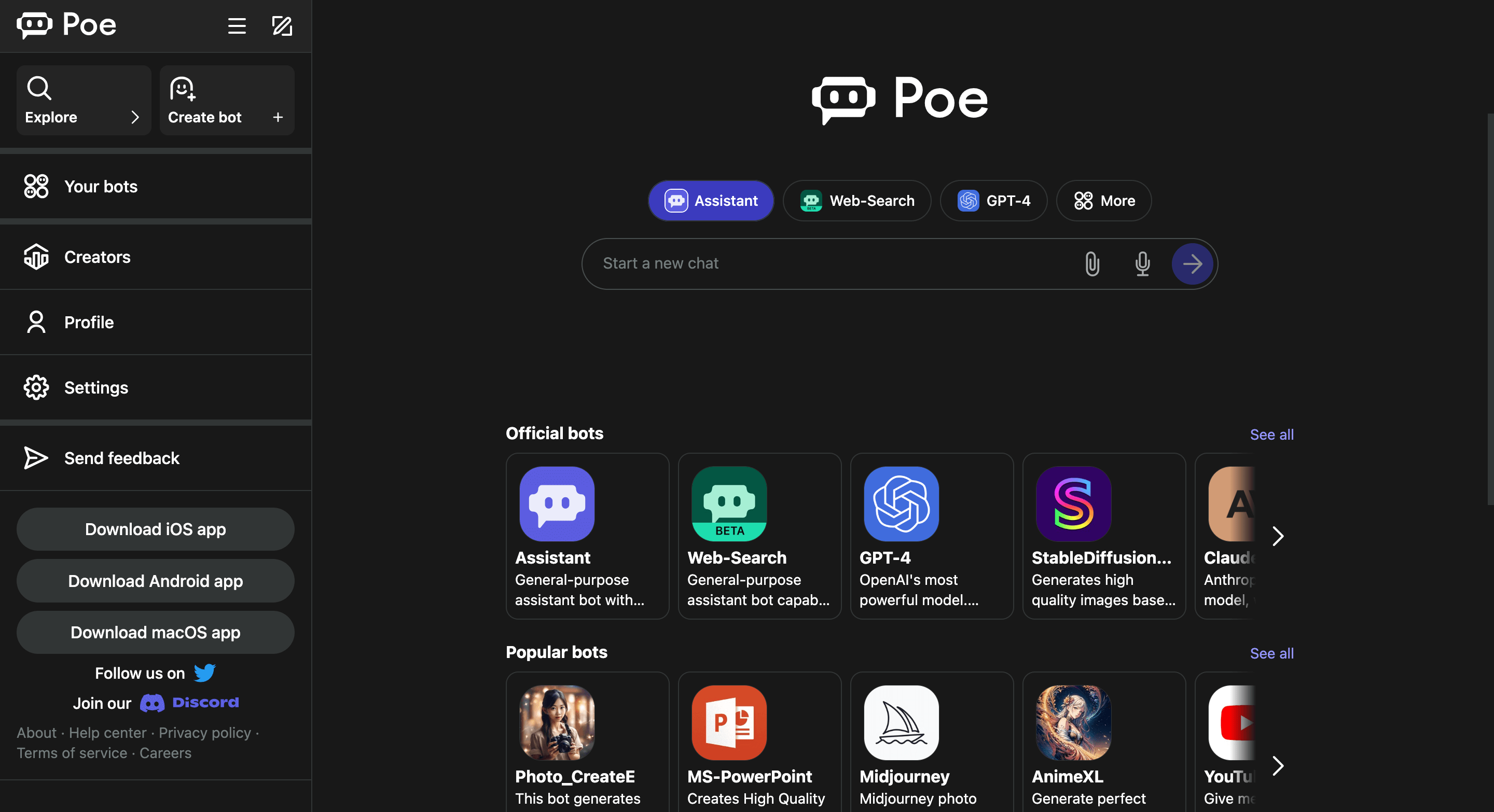
It’s designed to be user-friendly and brings together various AI chatbots in one convenient space. It was initially designed for mobile use, but they recently launched a web interface too.
What’s really neat is that you can explore different bots created by other users, ranging from turning your sentences into emojis to having a virtual life coach. It’s a fascinating blend of artificial intelligence and social media.
Key features:
- Poe offers a range of chatbots with different personalities and expertise.
- Each chatbot is trained on different data and is designed to assist with various tasks, and has different areas of knowledge.
- It supports URL fetching and document uploading, allowing users to ask questions about web pages or documents.
- It provides access to multiple language models, making start-up chatbots available to a wider audience.
- Users can explore and use bots created by others
Pricing: Poe is free to use, so you can access various language models. However, there is a usage limit. Poe subscriptions are currently limited to certain countries and platforms.
Final Words
These are the best ChatGPT alternatives you can try right now.
Each one solves a different kind of problem. Some are better for research, some for coding, some for privacy, and some for speed.
Take a bit of time and test them yourself. And yes, always check the pricing before you commit.
Pick what actually fits the way you work.