You can sell a product, get real orders, and still end up with less money than you had before.
Yes, that can happen.
But not because the product was bad, not because the idea failed, but simply because the money side was never figured out carefully.
That’s the part you rarely hear about, even from YouTube creators.
Content about starting a product business often goes straight to finding a supplier, building a store, and getting traffic.
And the budget part gets a little mention, maybe a spreadsheet template, and that’s it.
But the budget is the business, especially when you’re selling physical products, because costs are everywhere and a lot of them are hiding in places you would never think to look.
Here’s what a small business budget actually looks like when you’re selling any product in 2026.
Disclosure: This post has affiliate links. I earn a commission if you buy, at no extra cost to you.
What Your Product Actually Costs to Bring In
This is probably the most common mistake any new business owner can make.
They find something on Aliexpress for $8, plan to sell it for $25, and think the math works. The $17 difference is not your profit. From what I found, not even close.
What actually matters is your landed cost.
That’s the real number, the full cost of getting one unit from wherever it’s made all the way to your door, ready to ship to a customer.
And it includes a lot more than what the supplier quotes.
So yes, you have to add the shipping cost from the factory, import duties, your packaging, and sometimes inspection fees if you’re checking the quality of a larger order.

If you do that math correctly, you’ll see that a product that costs $8 from a supplier can easily cost $13 or $15 by the time it actually arrives.
And that’s before you’ve packed it in a box or paid to ship it to anyone.
This is also something a lot of product sellers underestimate. Wherever you’re based, import duties and customs fees are a real cost when sourcing from overseas, and they add up faster than you’d expect.
It’s always worth checking with your local customs office or a freight forwarder before you place your first order, so you know what the final cost will look like.

The Costs That Don’t Show Up Until It’s Too Late
Once you have your landed cost figured out, there’s still a whole list of things quietly eating into your budget that most people don’t even plan for.
Packaging is a good example here. At first, it seems like a small cost, but it adds up with every order.
A basic poly mailer costs roughly $0.15 to $0.70 per unit, depending on the size and how many you order. Custom printed boxes are $1.50 to $4.50 per order, sometimes more.
And if you add branded tissue and a sticker, a complete unboxing experience can easily cost around $3 to $4.50 per order. Not once, every time someone buys from you.
Product photography is another one that surprises people.
You need images that make someone actually want to buy, and some random phone photos often aren’t enough when you’re competing with stores that look professional.
Product photography can cost anywhere from $300 to $700 for a first product launch if you hire a photographer, depending on how many photos you need and the type of photos you want.
But if you have an iPhone or another smartphone with a good camera, this might not be that much of a headache.
All you need is some YouTube tutorials and a few accessories to make it work.
Next, returns are maybe the most painful because you’re losing money on something you already sold. Some research even shows that about 19.3% of online sales get returned, which is roughly one in five.
Processing each return can cost $15 to $30 once you stack return shipping, inspection, restocking time, and payment processing fees that may not be refunded.
I’m not telling you this to scare you, but it’s another part of the business you might not even think about at first.
The better way to handle this is to expect it and include it in your pricing from the start, instead of treating it like a surprise that happens sometimes.
Then there are payment processing fees, which are easy to forget because they happen automatically. With Stripe’s standard US pricing, a domestic card sale costs around 2.9% plus $0.30.
So, on a $25 order, that’s about $1.03 gone from each transaction. That $17 difference from the $8 product we talked about earlier is already down to $15.97 before you even account for the other costs.
None of these costs look huge on their own, and that’s exactly what makes them so easy to miss.
Three Buckets to Track (and the One Most People Skip)
A bucket here just means a category, a place where a specific type of cost lives. Everything goes into one of three of them.
I’m going to keep this budget structure simple.
The first is fixed costs.
These are things you still have to pay for, no matter how many orders you get. Your store platform, like Shopify, software subscriptions, your domain, and any monthly apps.
They’re predictable and easy to plan around because they don’t change based on sales volume.
Most of us track these pretty well because they show up on our credit card statement every month, and we know we have to pay them.
The second is variable costs.
This is where your profit margin can either work well or get squeezed.
Everything that changes based on how many orders you fulfill goes here. Think about product costs, packaging, outbound shipping, payment processing, and returns.
The more you sell, the more you spend here.
And yes, these costs are not always that obvious, so most people roughly track this bucket and leave out the small details until the numbers stop making sense.
That’s usually when they realize a product they thought was profitable actually wasn’t.
The third bucket is your reserve, and this is the one most people forget to include.
The idea is simple, though. A portion of whatever comes in, around 10 to 20%, goes into a separate account and stays there.
It covers slow months, a return spike after the holidays, a supplier price increase you didn’t see coming, anything that goes, I would say, sideways.
I know, it sounds like you’re just keeping money there and not using it.
But cash flow problems are more common than you might think. According to QuickBooks, about 44% of small businesses report having cash flow problems.
The reserve isn’t money you should plan to spend. It’s the thing that keeps one bad month from becoming the end of something that was actually working.
For tools to actually track all of this, QuickBooks is probably the most popular choice for small US businesses, and it handles inventory tracking well once you’re doing real volume.
Also, a spreadsheet is totally fine in the early days, as long as you keep an eye on it regularly, which is the harder part anyway.
The Pricing Mistake That Quietly Ruins Margins
There’s a concept called keystone pricing.
The term is traced back to the jewelry trade in the late 1800s, and somehow, it became a common rule in retail.
What it simply means is, you take your cost and double it.
For example, if your landed cost is $12, you sell for $24. That gives you a 50% gross margin, which is roughly the minimum a physical product business needs to stay healthy.
The problem you might make is using this math on the supplier price instead of the landed cost. You take that $8 quote, double it, sell for $16, and think you have a 50% margin.
But by the time the real landed cost is $14 or $15, the actual margin is much thinner. And once you subtract fees, shipping, returns, and any marketing spend, there may be very little left from each order.
Even if you use keystone pricing correctly, a 50% gross margin doesn’t mean you keep 50%.
Small product businesses can end up with net margins in the low single digits, with around 2% to 10% being a reasonable broad range for retail.
That gap between what you make on paper and what you actually keep is where fees, returns, customer acquisition costs, and overhead add up.
So every pricing decision has to start with the real cost, the full landed cost, instead of taking the easy shortcut.
And don’t forget to set aside a portion of your earnings for taxes throughout the year. The amount depends on where you live and your business setup, so it’s worth checking with a local accountant if you’re not sure.
Where You Sell Affects Your Budget More Than You Think
This one’s easy to miss until it comes back to bite you.
Most people choose a selling platform based on what they’ve heard or what feels familiar, not based on actual fee math.
Which makes sense when you’re starting something for the first time, but it’s worth understanding what you’re actually paying.
Marketplaces like Etsy and Amazon can bring you traffic and customers, and that’s pretty valuable when you’re starting with no audience.
But they take a real cut of every sale. Etsy charges a 6.5% transaction fee, plus a $0.20 listing fee and payment processing fees that vary by country. Amazon often charges around 15% in referral fees, with FBA fulfillment costs on top of that.
A dedicated store through something like Shopify works differently.
You pay a flat monthly subscription ($39 on the Basic plan, or $29 billed annually) and a processing fee of around 2.9% plus $0.30 per sale if you use Shopify Payments.
→ Start building your store now (free for 3 days, no credit card needed), then pick a plan that fits
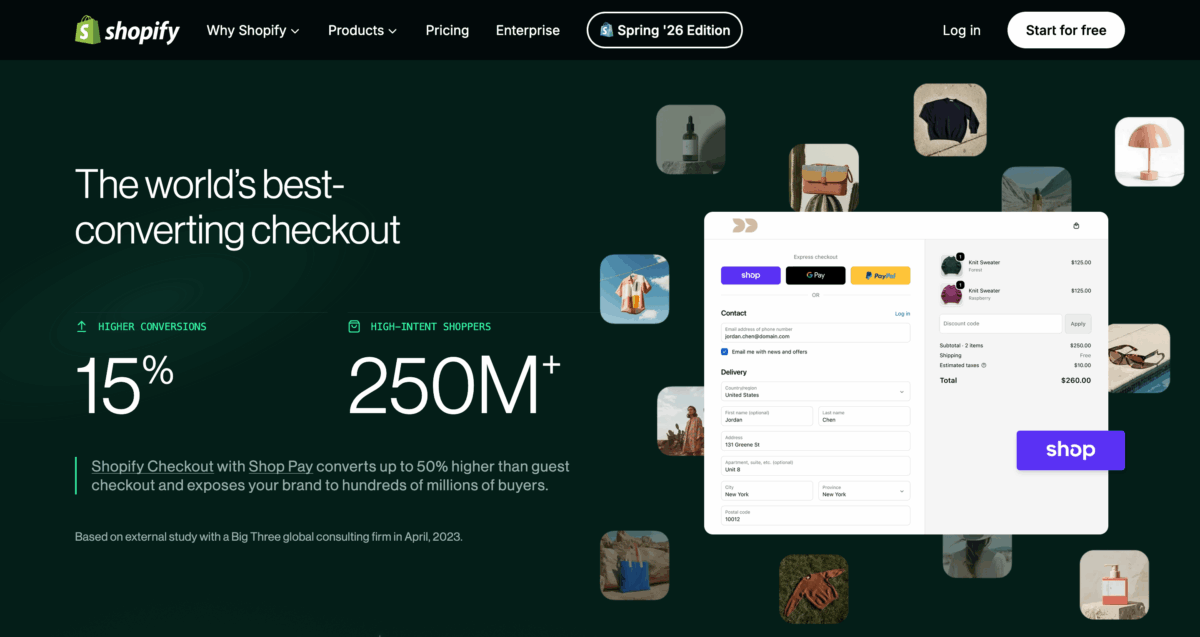
There’s no marketplace taking a percentage of every order forever. But yes, you lose that easy exposure, and that’s also what you’re paying for by being listed on a marketplace, though.
The math starts to favor a dedicated store pretty clearly once you’re doing more than $1,000 to $1,300 a month in sales. Below that, marketplaces can make sense because you’re not yet set up to drive your own traffic.
Above that, the fees you’re paying a marketplace typically cost more than what you’d pay running your own online store.
| Compare | Etsy | Shopify Basic |
|---|---|---|
| Monthly fee | None | $39/month ($29 billed annually) |
| Transaction fee | 6.5% per sale | None with Shopify Payments |
| Payment processing | ~3% + $0.25 (US) | 2.9% + $0.30 |
| Listing fee | $0.20 per listing (every 4 months) | None |
| Built-in traffic | Yes, 90M+ active buyers | Shop app (250M shoppers) |
| Brand control | Limited | Full |
| Customer ownership | Etsy owns the relationship | You own it |
| Offsite ads fee | 12-15% when over $10K/year | Not applicable |
| Best for | Starting with zero audience | Growing with an existing audience |
According to a fee comparison I did between Shopify and Etsy, switching to your own store at higher volumes can save you hundreds of dollars per month in fees alone.
That’s real money every month that stays in your pocket instead of going to the marketplace.
And yes, again, the trade-off is that your own store doesn’t bring you customers. You have to drive your own traffic through SEO, social, email, or ads, but Shopify now has its own Shop app, so it could be useful too.
So a smart play for a lot of new businesses is to start on a marketplace to validate that the product actually sells, then move to or add a dedicated store once demand is confirmed.
Shopify currently has a trial where you get 3 days free and then $1 a month for 3 months, so there’s not much risk in setting something up alongside wherever you’re already selling.
The Cash Flow Problem Product Sellers Don’t See Coming
This one is different from profit, and it trips up a lot of people who are otherwise doing things right.
With a product business, money leaves your account when you order inventory. That can be 90 to 120 days before you actually sell that stock and get paid for it.
So you have real money just locked up inside boxes, on a shelf somewhere, doing nothing.
And the whole time that’s happening, the store subscription is still running, apps are still charging, maybe ads are running. Money keeps going out before it comes back in.
Nearly 4 in 10 US small businesses have less than a month of operating expenses in cash.
If sales slow down, a supplier delays a shipment, or a bunch of post-holiday returns comes in at once, having less than a month of runway can get pretty serious pretty quickly.
This is why the reserve bucket I discussed earlier isn’t optional. It’s not savings. It’s the gap between a rough month and a closed business.
And a simple habit like a quick weekly cash check, not a full accounting review, just: what came in this week, what went out, and what’s in the account right now, would be a big help here.
I know, it might sound like something you don’t really want to do.
But it’s one of the most useful things you can do, because by the time a cash problem feels urgent, you probably should have done something about it two or three weeks ago.
Money Habits That Matter From Day One
One of the first things to get right is keeping personal and business money separate. If not, it makes taxes a mess, makes it really hard to see how the business is actually doing, and makes it harder to tell what money is yours to spend and what needs to stay in the business.
Open a separate business bank account from day one. It costs nothing and it forces you to treat the business like an actual separate thing.
Buying too much inventory too early is another one.
The per-unit cost drops when you order in volume, so there’s always a temptation to go big on the first order.
But if demand isn’t what you expected, you’ve got money tied up in products you can’t sell, and storing unsold stock costs you money every month it just sits there.
According to a Netstock study, about 55% of small and medium-sized businesses reported carrying at least 20% excess stock. Order small, make sure the product actually sells, then reorder.
Then there’s spending on ads before the product is even proven to sell, or we can say validated. This can be one of the fastest ways to burn through a budget with nothing to show for it.
If you don’t yet know the product sells, paid ads will mostly just teach you an expensive lesson.
You need to get some organic sales first, even just a few, before you put real money into ads.
Before You Order Anything
And when you step back and look at it, most product businesses that run out of money don’t fail because the product is bad.
They fail because the numbers were never really figured out before the money started moving.
The supplier price looked fine, the margin looked fine, and then the real costs started creeping in, and there was nothing left to cover them.
The best move is to figure out your landed cost before you order anything.
Price off that number, not the supplier quote.
And then, set aside a reserve from the beginning, check the cash more often than feels necessary, because the times it doesn’t feel necessary are usually exactly when you should be looking.